SkillHub by Spacelinkers Logo
    HomeJobsBlogsAboutContact

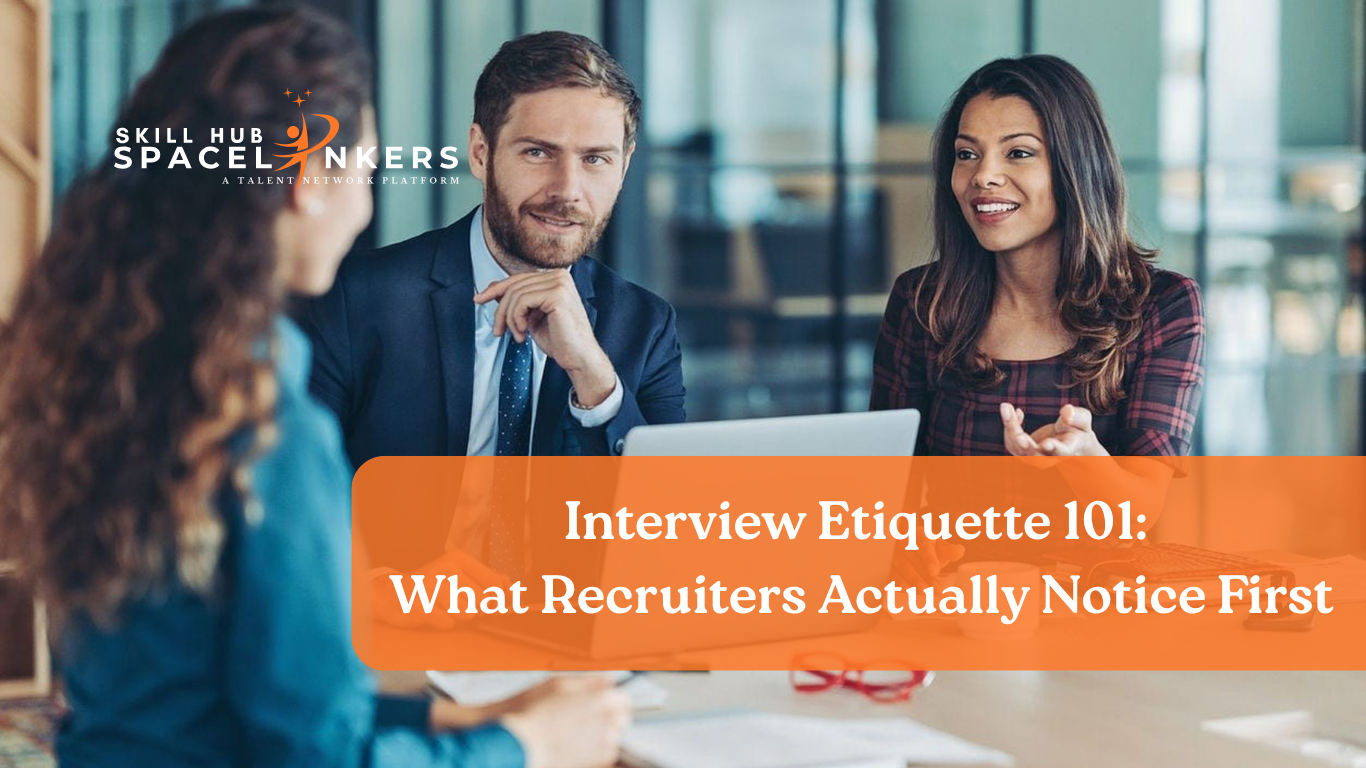
    Interview Etiquette 101: What Recruiters Actually Notice First

    You’ve applied, got shortlisted, and finally landed the interview. Now comes the real test — the first impression.

    At SkillHub, we’ve spoken to dozens of recruiters and hiring managers across industries, and one fact never changes:

    “Candidates often lose opportunities not because they lack skills — but because they lack awareness of interview etiquette.”

    Interview etiquette isn’t about acting fake or overly polished. It’s about projecting confidence, professionalism, and respect — whether you’re attending a face-to-face meeting or a virtual interview.

    This complete guide breaks down what recruiters actually notice first and how to stand out for the right reasons.

    Why Interview Etiquette Still Matters in 2025

    In the age of AI screening, video calls, and hybrid work, some candidates assume communication skills are secondary. That’s a myth.

    • Your interview behavior = workplace behavior predictor
    • Soft skills like clarity, listening, and punctuality show maturity
    • Recruiters use etiquette as a tie-breaker between two equally skilled candidates

    So, if you master both competence + conduct, you’re already in the top 10% of applicants.

    What Recruiters Notice in the First 10 Seconds

    Element Recruiter’s Perception
    Punctuality Respectful, reliable
    Appearance & posture Professionalism & confidence
    Greeting & tone Attitude & openness
    Eye contact Credibility & trust
    Energy level Motivation & enthusiasm

    💡 Pro Tip: Treat every interviewer like your future teammate, not an authority figure. You’re not begging for the job — you’re exploring a match.

    Step 1: Pre-Interview Preparation — More Than Just Practice

    1. Research the Company

    Recruiters expect you to know what the company does and why you’re applying. Check:

    • Company website (About Us + Careers page)
    • Latest LinkedIn posts or press releases
    • Product or service overview
    • Mission, values, and leadership team

    Example: “I noticed SkillHub recently launched a new job portal feature. I love how it simplifies candidate access — that’s exactly the kind of impact I want to be part of.”

    2. Study the Job Description

    Underline key skills or responsibilities and prepare a one-line story for each.

    Example: JD says: “Must have experience with API integration.”
    Your response: “In my last project, I integrated third-party APIs (Razorpay, SendGrid) into our Node.js backend to automate payment and email flows.”

    3. Prepare STAR Stories

    Behavioral questions should follow the STAR format:

    • Situation: Describe the context
    • Task: Explain your responsibility
    • Action: Describe what you did
    • Result: Share measurable outcomes

    Example: “We were missing project deadlines (Situation). I reorganized our sprint schedule (Action), which reduced backlog by 30% (Result).”

    4. Rehearse Introduction & “Tell Me About Yourself”

    Keep it short, clear, and confident. Duration: 45–60 seconds.

    Example: “I’m a Frontend Developer with 3 years of experience building React and Next.js applications. I love solving design-performance challenges, and I’m now looking for a role where I can combine my technical and leadership skills.”

    Tone: Clear, calm, confident.

    Step 2: Dress Code & Presentation

    You don’t need a suit — but you do need to look prepared. Here's what to wear based on interview type:

    Interview Type Recommended Attire
    Corporate (Finance/Consulting) Formal shirt & trousers / Saree / Blazer
    IT or Startup Business casuals (no T-shirts with prints)
    Creative / Design Smart casuals with neat grooming
    Remote Interview Plain background, well-lit room, collared shirt

    💡 Small details matter:

    • Iron your clothes
    • Avoid strong perfumes or flashy accessories
    • Keep hair clean and tidy

    Remember — your goal is to remove distractions so the recruiter can focus on your words.

    Step 3: Punctuality & Virtual Setup

    Being on time and having a professional setup is critical — both offline and online.

    For Offline Interviews:

    • Arrive 10–15 minutes early
    • Keep an extra copy of your resume (printed on A4)
    • Carry a pen and notepad

    For Online Interviews:

    • Test your microphone, webcam, and internet speed
    • Rename your Zoom/Teams ID professionally (e.g., Rahul Verma — Frontend Developer)
    • Sit near a plain, well-lit background
    • Mute phone notifications

    💡 Pro Tip:

    Log in 5 minutes early — recruiters notice punctuality even in virtual settings.

    Step 4: Greeting and Body Language

    Your greeting and body language set the tone for the entire interview. Here’s how to make a great impression:

    1. Greet with Confidence

    Smile naturally, maintain eye contact, and greet politely:

    "Good morning, thank you for having me."

    - Video interview: Nod instead of shaking hands
    - In-person: Offer a firm handshake (not crushing)

    2. Maintain Good Posture

    Sit upright, lean slightly forward, and avoid crossing your arms. Your posture conveys confidence and engagement even before you speak.

    3. Use Controlled Hand Gestures

    Moderate hand movements show confidence; over-gesturing seems nervous. Keep your hands visible (not in pockets).

    Step 5: During the Interview — Communication Etiquette

    1. Listen Before You Speak

    Don’t rush to answer — pause for 1–2 seconds after a question. It shows thoughtfulness, not hesitation.

    2. Be Concise

    Answer in 2–3 sentences unless more detail is requested. Avoid overexplaining or repeating the question.

    3. Match Energy, Not Ego

    Mirror the interviewer’s tone. Formal = formal; conversational = slightly relaxed.

    4. Admit Gaps Honestly

    Example response:

    "I haven’t worked on that yet, but I understand the concept and would love to explore it."

    5. Don’t Interrupt

    If you accidentally cut in, say:

    "Sorry, please continue — I didn’t mean to interrupt."


    FAQs: Interview Etiquette

    Q1. Should I send a thank-you email after every interview?

    👉 Yes, it shows appreciation and keeps you top of mind.

    Q2. How early should I join an online interview?

    👉 5 minutes early is ideal.

    Q3. What if I’m nervous or stammer during the interview?

    👉 Smile, pause, and continue. Recruiters value composure over perfection.

    Q4. Should I discuss salary in the first round?

    👉 Only if the interviewer brings it up. Focus first on role fit.

    Q5. Can SkillHub help me prepare for interviews?

    👉 Yes — SkillHub regularly shares recruiter-verified interview questions, preparation guides, and real success stories.

    Step 7: Virtual Interview Manners (2025 Rules)

    • Maintain eye contact — look at the camera, not the screen.
    • Keep facial expressions natural — avoid staring or excessive nodding.
    • Close irrelevant browser tabs and mute notifications.
    • Don’t multitask — recruiters can sense distraction.
    • Use professional usernames and email addresses.

    Avoid: eating, slouching, background noise, or talking over others.

    Step 8: Ending the Interview Gracefully

    1. Thank the interviewer for their time.
    2. Reaffirm interest:

      Example: “I’m very excited about this role — it aligns with my skill set and what I’m looking for next.”

    3. Ask politely about the next steps.
    4. End with a confident smile or nod.

    💡 Pro Tip: Send a short thank-you email within 24 hours.

    Step 9: Post-Interview Etiquette (Follow-up)

    ✅ Thank-You Email Sample:

    Subject: Thank You — Rahul Verma, Frontend Developer

    Hi [Interviewer Name],

    Thank you for the opportunity to interview for the Frontend Developer role today. I truly enjoyed learning more about SkillHub’s projects.

    I’m excited about the possibility of contributing my React and Next.js expertise to the team.

    Best regards,
    Rahul Verma
    LinkedIn | +91-XXXXXXXXXX

    Common Interview Mistakes to Avoid

    Mistake Why It’s a Problem
    Arriving late Shows lack of responsibility
    Poor grooming Unprofessional impression
    Speaking negatively about past employers Shows immaturity
    Interrupting interviewer Disrespectful
    Overusing “we” instead of “I” Hides ownership
    No questions at the end Shows disinterest
    Not following up Missed opportunity

    What Recruiters Secretly Judge (But Never Say)

    • Confidence without arrogance
    • Body language consistency
    • Eye contact when answering technical questions
    • Curiosity (asking “why,” not just “how”)
    • Clarity in communication (no filler words like “umm” or “like”)
    • Gratitude — humble tone always wins over overconfidence

    Bonus: For Group or Panel Interviews

    • Greet each panel member individually.
    • Make eye contact with the person asking, but glance at others occasionally.
    • Avoid dominating conversation.
    • Bring notes, but don’t read from them.
    • Thank the entire panel before leaving.

    SkillHub’s Pro Insight

    “We’ve seen great candidates lose interviews because of poor etiquette — talking over others, arriving late, or not knowing about the company. The best hires are those who communicate with respect, curiosity, and authenticity.” — Spacelinkers Recruitment Team (2025)

    SkillHub aims to help candidates not just find jobs — but get hired. That’s why we focus on resume readiness, application quality, and interview coaching through blog resources like this.

    FAQs: Interview Etiquette for 2025

    Q1. Should I send a thank-you email after every interview?

    👉 Yes, it shows appreciation and keeps you top of mind.

    Q2. How early should I join an online interview?

    👉 5 minutes early is ideal.

    Q3. What if I’m nervous or stammer during the interview?

    👉 Smile, pause, and continue. Recruiters value composure over perfection.

    Q4. Should I discuss salary in the first round?

    👉 Only if the interviewer brings it up. Focus first on role fit.

    Q5. Can SkillHub help me prepare for interviews?

    👉 Yes — SkillHub regularly shares recruiter-verified interview questions, preparation guides, and real success stories.

    Conclusion

    A great interview isn’t just about answering questions correctly — it’s about how you present your personality, confidence, and respect for the process.

    The right etiquette transforms you from “just another applicant” into a memorable professional.

    Before your next interview:

    • Research deeply
    • Prepare STAR stories
    • Dress sharp
    • Be on time
    • Listen actively
    • Follow up politely

    That’s how candidates get noticed, remembered, and hired .

    Call to Action:

    Ready to apply your interview etiquette in the real world? Visit SkillHub.sbs — explore verified jobs, apply easily, and get personalized responses from the hiring team.

    Because your first impression starts the moment you click “Apply.”

    Back to Blogs
    Interview Etiquette 101: What Recruiters Actually Notice First
    Career Tips

    Interview Etiquette 101: What Recruiters Actually Notice First

    SkillHub Editorial
    10/13/2025
    8 min read

    You’ve applied, got shortlisted, and finally landed the interview. Now comes the real test — the first impression.

    At SkillHub, we’ve spoken to dozens of recruiters and hiring managers across industries, and one fact never changes:

    “Candidates often lose opportunities not because they lack skills — but because they lack awareness of interview etiquette.”

    Interview etiquette isn’t about acting fake or overly polished. It’s about projecting confidence, professionalism, and respect — whether you’re attending a face-to-face meeting or a virtual interview.

    This complete guide breaks down what recruiters actually notice first and how to stand out for the right reasons.

    Why Interview Etiquette Still Matters in 2025

    In the age of AI screening, video calls, and hybrid work, some candidates assume communication skills are secondary. That’s a myth.

    • Your interview behavior = workplace behavior predictor
    • Soft skills like clarity, listening, and punctuality show maturity
    • Recruiters use etiquette as a tie-breaker between two equally skilled candidates

    So, if you master both competence + conduct, you’re already in the top 10% of applicants.

    What Recruiters Notice in the First 10 Seconds

    Element Recruiter’s Perception
    Punctuality Respectful, reliable
    Appearance & posture Professionalism & confidence
    Greeting & tone Attitude & openness
    Eye contact Credibility & trust
    Energy level Motivation & enthusiasm

    💡 Pro Tip: Treat every interviewer like your future teammate, not an authority figure. You’re not begging for the job — you’re exploring a match.

    Step 1: Pre-Interview Preparation — More Than Just Practice

    1. Research the Company

    Recruiters expect you to know what the company does and why you’re applying. Check:

    • Company website (About Us + Careers page)
    • Latest LinkedIn posts or press releases
    • Product or service overview
    • Mission, values, and leadership team

    Example: “I noticed SkillHub recently launched a new job portal feature. I love how it simplifies candidate access — that’s exactly the kind of impact I want to be part of.”

    2. Study the Job Description

    Underline key skills or responsibilities and prepare a one-line story for each.

    Example: JD says: “Must have experience with API integration.”
    Your response: “In my last project, I integrated third-party APIs (Razorpay, SendGrid) into our Node.js backend to automate payment and email flows.”

    3. Prepare STAR Stories

    Behavioral questions should follow the STAR format:

    • Situation: Describe the context
    • Task: Explain your responsibility
    • Action: Describe what you did
    • Result: Share measurable outcomes

    Example: “We were missing project deadlines (Situation). I reorganized our sprint schedule (Action), which reduced backlog by 30% (Result).”

    4. Rehearse Introduction & “Tell Me About Yourself”

    Keep it short, clear, and confident. Duration: 45–60 seconds.

    Example: “I’m a Frontend Developer with 3 years of experience building React and Next.js applications. I love solving design-performance challenges, and I’m now looking for a role where I can combine my technical and leadership skills.”

    Tone: Clear, calm, confident.

    Step 2: Dress Code & Presentation

    You don’t need a suit — but you do need to look prepared. Here's what to wear based on interview type:

    Interview Type Recommended Attire
    Corporate (Finance/Consulting) Formal shirt & trousers / Saree / Blazer
    IT or Startup Business casuals (no T-shirts with prints)
    Creative / Design Smart casuals with neat grooming
    Remote Interview Plain background, well-lit room, collared shirt

    💡 Small details matter:

    • Iron your clothes
    • Avoid strong perfumes or flashy accessories
    • Keep hair clean and tidy

    Remember — your goal is to remove distractions so the recruiter can focus on your words.

    Step 3: Punctuality & Virtual Setup

    Being on time and having a professional setup is critical — both offline and online.

    For Offline Interviews:

    • Arrive 10–15 minutes early
    • Keep an extra copy of your resume (printed on A4)
    • Carry a pen and notepad

    For Online Interviews:

    • Test your microphone, webcam, and internet speed
    • Rename your Zoom/Teams ID professionally (e.g., Rahul Verma — Frontend Developer)
    • Sit near a plain, well-lit background
    • Mute phone notifications

    💡 Pro Tip:

    Log in 5 minutes early — recruiters notice punctuality even in virtual settings.

    Step 4: Greeting and Body Language

    Your greeting and body language set the tone for the entire interview. Here’s how to make a great impression:

    1. Greet with Confidence

    Smile naturally, maintain eye contact, and greet politely:

    "Good morning, thank you for having me."

    - Video interview: Nod instead of shaking hands
    - In-person: Offer a firm handshake (not crushing)

    2. Maintain Good Posture

    Sit upright, lean slightly forward, and avoid crossing your arms. Your posture conveys confidence and engagement even before you speak.

    3. Use Controlled Hand Gestures

    Moderate hand movements show confidence; over-gesturing seems nervous. Keep your hands visible (not in pockets).

    Step 5: During the Interview — Communication Etiquette

    1. Listen Before You Speak

    Don’t rush to answer — pause for 1–2 seconds after a question. It shows thoughtfulness, not hesitation.

    2. Be Concise

    Answer in 2–3 sentences unless more detail is requested. Avoid overexplaining or repeating the question.

    3. Match Energy, Not Ego

    Mirror the interviewer’s tone. Formal = formal; conversational = slightly relaxed.

    4. Admit Gaps Honestly

    Example response:

    "I haven’t worked on that yet, but I understand the concept and would love to explore it."

    5. Don’t Interrupt

    If you accidentally cut in, say:

    "Sorry, please continue — I didn’t mean to interrupt."


    FAQs: Interview Etiquette

    Q1. Should I send a thank-you email after every interview?

    👉 Yes, it shows appreciation and keeps you top of mind.

    Q2. How early should I join an online interview?

    👉 5 minutes early is ideal.

    Q3. What if I’m nervous or stammer during the interview?

    👉 Smile, pause, and continue. Recruiters value composure over perfection.

    Q4. Should I discuss salary in the first round?

    👉 Only if the interviewer brings it up. Focus first on role fit.

    Q5. Can SkillHub help me prepare for interviews?

    👉 Yes — SkillHub regularly shares recruiter-verified interview questions, preparation guides, and real success stories.

    Step 7: Virtual Interview Manners (2025 Rules)

    • Maintain eye contact — look at the camera, not the screen.
    • Keep facial expressions natural — avoid staring or excessive nodding.
    • Close irrelevant browser tabs and mute notifications.
    • Don’t multitask — recruiters can sense distraction.
    • Use professional usernames and email addresses.

    Avoid: eating, slouching, background noise, or talking over others.

    Step 8: Ending the Interview Gracefully

    1. Thank the interviewer for their time.
    2. Reaffirm interest:

      Example: “I’m very excited about this role — it aligns with my skill set and what I’m looking for next.”

    3. Ask politely about the next steps.
    4. End with a confident smile or nod.

    💡 Pro Tip: Send a short thank-you email within 24 hours.

    Step 9: Post-Interview Etiquette (Follow-up)

    ✅ Thank-You Email Sample:

    Subject: Thank You — Rahul Verma, Frontend Developer

    Hi [Interviewer Name],

    Thank you for the opportunity to interview for the Frontend Developer role today. I truly enjoyed learning more about SkillHub’s projects.

    I’m excited about the possibility of contributing my React and Next.js expertise to the team.

    Best regards,
    Rahul Verma
    LinkedIn | +91-XXXXXXXXXX

    Common Interview Mistakes to Avoid

    Mistake Why It’s a Problem
    Arriving late Shows lack of responsibility
    Poor grooming Unprofessional impression
    Speaking negatively about past employers Shows immaturity
    Interrupting interviewer Disrespectful
    Overusing “we” instead of “I” Hides ownership
    No questions at the end Shows disinterest
    Not following up Missed opportunity

    What Recruiters Secretly Judge (But Never Say)

    • Confidence without arrogance
    • Body language consistency
    • Eye contact when answering technical questions
    • Curiosity (asking “why,” not just “how”)
    • Clarity in communication (no filler words like “umm” or “like”)
    • Gratitude — humble tone always wins over overconfidence

    Bonus: For Group or Panel Interviews

    • Greet each panel member individually.
    • Make eye contact with the person asking, but glance at others occasionally.
    • Avoid dominating conversation.
    • Bring notes, but don’t read from them.
    • Thank the entire panel before leaving.

    SkillHub’s Pro Insight

    “We’ve seen great candidates lose interviews because of poor etiquette — talking over others, arriving late, or not knowing about the company. The best hires are those who communicate with respect, curiosity, and authenticity.” — Spacelinkers Recruitment Team (2025)

    SkillHub aims to help candidates not just find jobs — but get hired. That’s why we focus on resume readiness, application quality, and interview coaching through blog resources like this.

    FAQs: Interview Etiquette for 2025

    Q1. Should I send a thank-you email after every interview?

    👉 Yes, it shows appreciation and keeps you top of mind.

    Q2. How early should I join an online interview?

    👉 5 minutes early is ideal.

    Q3. What if I’m nervous or stammer during the interview?

    👉 Smile, pause, and continue. Recruiters value composure over perfection.

    Q4. Should I discuss salary in the first round?

    👉 Only if the interviewer brings it up. Focus first on role fit.

    Q5. Can SkillHub help me prepare for interviews?

    👉 Yes — SkillHub regularly shares recruiter-verified interview questions, preparation guides, and real success stories.

    Conclusion

    A great interview isn’t just about answering questions correctly — it’s about how you present your personality, confidence, and respect for the process.

    The right etiquette transforms you from “just another applicant” into a memorable professional.

    Before your next interview:

    • Research deeply
    • Prepare STAR stories
    • Dress sharp
    • Be on time
    • Listen actively
    • Follow up politely

    That’s how candidates get noticed, remembered, and hired .

    Call to Action:

    Ready to apply your interview etiquette in the real world? Visit SkillHub.sbs — explore verified jobs, apply easily, and get personalized responses from the hiring team.

    Because your first impression starts the moment you click “Apply.”

    Related Articles

    No related articles found.
    SkillHub - A Talent Network Platform

    Connecting talented professionals with their dream careers. Your journey to success starts here.

    Verified Platform
    Owned By Spacelinkers

    Quick Links

    • Home
    • Jobs
    • About Us
    • Blogs
    • Contact Us

    Resource

    • Post a job
    • Edit Profile
    • Hire from SkillHub
    • Submit your Resume
    • Join SkillHub Channel

    Categories

    • Design
    • Finance
    • Marketing
    • Sales
    • Technology

    By Country

    • Jobs in Canada
    • Jobs in China
    • Jobs in Germany
    • Jobs in India
    • Jobs in US
    • Jobs in UK
    Newsletter

    Stay Ahead in Your Career

    Join 50,000+ professionals receiving weekly job alerts, industry insights, and exclusive career opportunities.

    Free forever. Unsubscribe anytime.

    Your Gateway to Global Career Opportunities

    SkillHub is India's premier job platform connecting talented professionals with their dream careers across the globe. Whether you're searching for jobs in India, jobs in the United States, jobs in the United Kingdom, jobs in Canada, jobs in Germany, jobs in China, or remote opportunities, we provide access to thousands of verified openings. Explore career opportunities in Design, Technology, Finance, Marketing, Sales, and more across major cities including Mumbai, Delhi, Bangalore, Pune, Hyderabad, Chennai, New York, London, Beijing and Toronto. Our platform features positions from 500+ top companies and serves over 50,000 active job seekers. Start your journey to career success with SkillHub today.

    © 2025 SkillHub by Spacelinkers. All rights reserved.

    Terms of Use|Privacy Policy